Building a prototype Cornish-to-IPA converter
Why I tried this
As a learner of Cornish, I often come across new written words without being completely sure how to pronounce them.
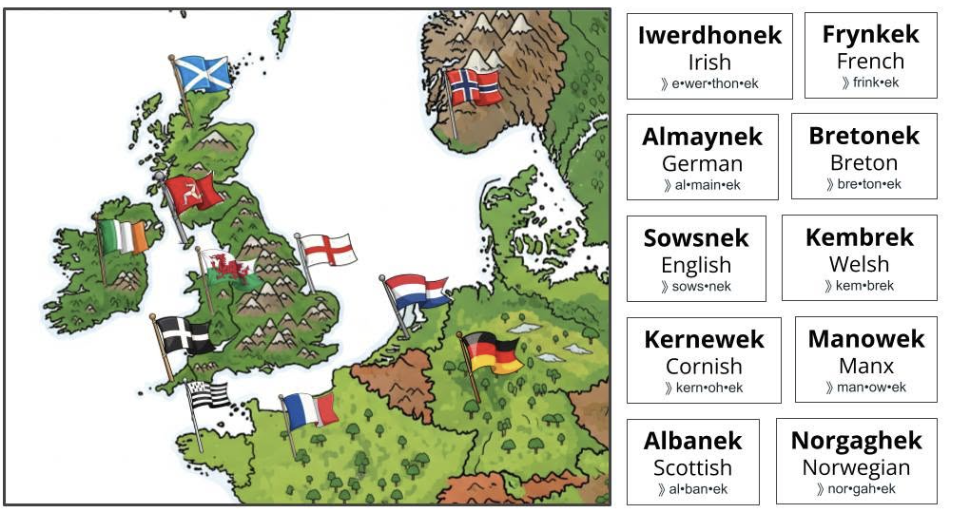
Illustrated vocabulary resources can help me connect a Cornish word with its meaning and spelling. The example below, which I found on Facebook, is attractive and memorable. However, spelling alone does not always tell me everything I want to know about pronunciation.
Take the word Kernewek. As a learner, I may want to know:
- which syllable carries the stress;
- how the vowels are pronounced;
- whether any vowel is reduced;
- and how the whole word should sound when spoken naturally.
A recording can answer these questions, but recordings are not available for every word. I therefore began experimenting with a simple tool that converts written Cornish into the International Phonetic Alphabet.
Demonstration
The prototype is available here:
[Open the Cornish-to-IPA converter]
A user enters a Cornish word, and the converter produces an IPA transcription. For example:
Kernewek → /kɛrˈnɛwɛk/
The transcription shows more than the ordinary spelling alone can provide.
What the IPA tells me
In an IPA transcription:
- the stress mark indicates which syllable is stressed;
- each symbol represents a particular speech sound;
- the transcription can show vowel quality and, where relevant, vowel length;
- it can also show whether a vowel is pronounced fully or reduced.
This gives learners a compact way of checking how a word is intended to be pronounced.
The converter is still only a prototype. It represents a particular set of pronunciation rules and does not yet account for all the variation found in Cornish. Its output therefore needs to be checked against reliable sources and reviewed by knowledgeable speakers.
What this shows
For a language with limited pronunciation resources, even a simple rule-based converter could be useful. It could help learners check unfamiliar words, notice stress patterns and become more confident about reading Cornish aloud.
The wider idea may also be relevant to other minority languages. Where audio dictionaries are incomplete, a carefully designed text-to-IPA tool can provide an additional layer of pronunciation support.
However, such a tool should not be treated as a replacement for recordings or fluent speakers. It is best understood as a guide that supports further listening and learning.
Technical notes
The current version accepts a Cornish word, applies a set of pronunciation rules, and returns an IPA transcription.
I did not write the code myself. I described the tool I wanted to ChatGPT and asked it to generate the code. I then copied the code, tested it, and uploaded it to my server.
This shows that someone without programming expertise can create a working prototype by describing the idea to an AI tool, then testing and publishing the resulting code.
The current version:
- accepts individual Cornish words;
- applies a set of pronunciation rules;
- returns an IPA transcription;
- is still being tested and corrected.
The next stages are to improve its handling of vowel length, test a much larger range of words, document the pronunciation model being used, and incorporate feedback from reviewers.
Prag yth esov vy owth assaya hemma:
Avel dallethor, my a vynn godhvos fatel leveryr geryow. My a vynn godhvos mars yw bogalen hir po berr.
My a vynn godhvos ple’ma’n poslev.
Rag ow hweres vy, my a wovynnas orth ChatGPT dhe wul treyler IPA a dreyl geryow Kernewek yn skrif fonemek, neb yw gid fast dhe’n leveryans.
Hemm a re dhymm trawsskrif gans an kedhlow ma:
– ple’ma poslev an geryow
– pyth yw an son poran rag pub syllaben
– hys an vogalen — berr, hanter-hir, po hir